среда, 24 октября 2012 г.

Fooling Around With Unity3d

Having a long history of software development I decided to try and make a game based on Unity 3d technology. Yes, specifically for iOs. It's our religion, right? Right!
So far I realized that my knowledge of JavaScript isn't deep enough and probably wouldn't be sufficient for complex game dev, so I must learn C# first. But let's avoid boring stuff.

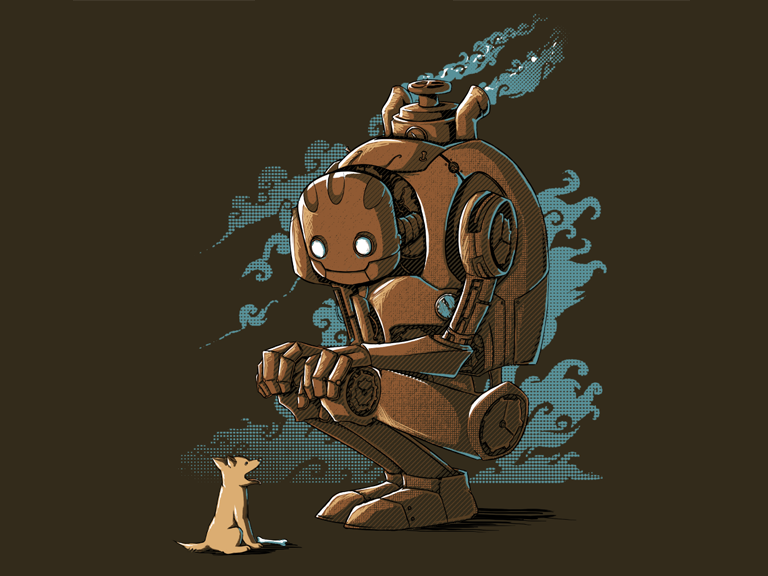
The idea for a game is as follows: a high-tech Steampunk droid with a dog's brain implanted in it is on a mission of escaping the evil genius laboratory. Angry guards try to stop it. Mad scientists place traps and land mines everywhere, so you gotta keep focused in order to stay in one piece.

It's gonna be almost impossible to complete the game. 100% of gaming skills required. Even hardcore gamers who are bored of easy stuff are recommended to consider not trying to make it. Cause it's gonna burn. It's gonna burn hard!

I will post all the updates on the whole process here, so stay in touch. Fun is coming!

вторник, 23 октября 2012 г.

How Steampunk Helped Me to Quit Smoking

Okay, guys, I quit smoking, I did it at last! It was tough and I couldn't really concentrate on pretty much anything.. Let me tell you how I did it and how Steampunk helped me to quit.

I used to be a heavy smoker (up to 2 packs a day) for 5 years. At first, I really liked this habit: I could socialize with lot of people who also smoked, I could concentrate better on any subject (coffee+cigarettes - classic huh?..) and I thought my young body regenerates faster than cigarettes destroy it. I was wrong on so many levels it's even hard to comprehend now..

About a year ago I tried to quit at first time. And I failed. It made me realize that I'm really addicted and something is very wrong. After that I kept trying to quit. Time after time I failed. Again and again. Keeping not smoking for just one day seemed almost impossible. I was desperate.

Until recently, when I discovered an amazing universe of Steampunk. It became my new addiction. While reading steampunk magazines or watching movies I was so into it, I forgot to smoke. It took 3 days for me to realize that a pack of smokes I bought 4 days ago is still not empty (well there was just one cigarette left, but anyway!). It struck me like a lightning! I found a substitute, and it does absolutely no harm to my health. Moreover, it's making me a better person!

Being a part of some culture and feeling it with your guts makes you stronger. You feel more confident when imagine all the people who like the same stuff you do. It gave me strenght to handle my habit. And I quit for good.

Haven't smoked for a month by now and nothing will make me smoke again. Steam only looks like a smoke. In reality it's made of water. Just like we all are.

четверг, 11 октября 2012 г.

Retrotronics. Yet Another Side of Steampunk

Retrotronics (a portmanteau of "retro" and "electronics", also retro-tronics) is the making of electric circuits or appliances using older electric components, such as vacuum tubes, Nixie displays, relays, uniselectors, analogue meters, etc. These are usually chosen for their aesthetic qualities, more than performance.
Retrotronics is a popular strand within the steampunk movement. At the Oxford exhibition of Steampunk art, a third of the works on show had a strong retrotronic influence, from light fittings of period components through to computer keyboards and webcams of burnished copper and brass. Outside steampunk, similar influences are found amongst the retro-futurist scene. A recent musical trend has sought to recapture early 1980s 8-bit game and synthesiser sounds, often referred to as Chiptune. Artists such as Kid Carpet perform entire sets on children's toys or pocket synths of the period. Other artists, such as Nullsleep, perform using only period video game hardware. DJs offer dance music events built from samples of period games or gadgets.

Some audiophiles and electric guitarists also favour the use of valve (vacuum tube) amplifiers, on the ground of sound quality or particular "colour". This is still within the scope of retrotronics, but is on a functional ground, rather than aesthetic. Designs of the 1960s are highly sought after today, and still support a market in manufacturing new valves and replacing time-expired components such as electrolytic capacitors.
In the audiophile world, such popularity is justified on the basis of sound quality, the earlier valve amplifier designs were free of such artifacts as crossover distortion that beset the early bipolar transistor designs of the 1960s. Despite more recent designs that have removed these problems, the "valve sound" is still preferred by some, who will pay large amounts to achieve it. It's also notable that almost all recent audiophile valve amplifiers make a deliberate display of their valves and place them visibly on show.
Another trend is the mixing of tubes with more up-to-date circuitry; these systems are referred to as a "hybrid systems". For example, in the Netherlands, the TubeSociety employs this technique.
Amongst guitarists, the goal of a "valve sound" is different, a deliberate distortion effect achieved through either over-driving valves, or through microphonics, the valve's sensitivity to air vibration as well as electrical signals. Original, or reproduction, guitar amplifiers such as the Vox AC30 now command a premium price.

One of the earlier examples of widespread retrotronics was the resurgent popularity of black Bakelite telephones in the UK. In the early 1980s, the UK domestic telephone market was deregulated and for the first time it was possible to legally purchase telephones outright and install them at home through a simple plug and socket. As well as the expected rush for modern lightweight handsets, there was also a brisk trade in 300 series telephones, refurbished internally to modern standards, but as a functional decorator item that appeared unchanged from the 1930s.

вторник, 9 октября 2012 г.

Growing Community

2006 saw the first "SalonCon", a neo-Victorian/steampunk convention. It ran for three consecutive years and featured artists, musicians (Voltaire and Abney Park), authors (Catherynne M. Valente, Ekaterina Sedia, and G. D. Falksen), salons led by people prominent in their respective fields, workshops and panels on steampunk—as well as a seance, ballroom dance instruction, and the Chrononauts' Parade. The event was covered by MTV and The New York Times. Since then a number of popular steampunk conventions have sprung up the world over, with names like Steamcon (Seattle, WA), the Steampunk World's Fair (Piscataway, NJ) and the World Steam Expo (Dearborn, MI).
Steampunk has also become a regular feature at San Diego Comic-Con International in recent years, with the Saturday of the four-day event being generally known among steampunks as "Steampunk Day", and culminating with a photo-shoot for the local press. In 2010 this was recorded in the Guinness Book of World Records as the world's largest steampunk photo shoot. The Saturday steampunk "after-party" has also become a major event on the steampunk social calendar; in 2010 the headliners included The Slow Poisoner, Unextraordinary Gentlemen and Voltaire, with Veronique Chevalier as Mistress of Ceremonies and special appearance by the League of STEAM and in 2011 UXG returned with Abney Park.
Steampunk also has sprung up recently at Renaissance Festivals and Renaissance Faires, nationwide. Some have organized events or a "Steampunk Day," while other Fests simply support an open environment for donning Steampunk attire. The Bristol Renaissance Faire in Kenosha, Wisconsin, on the Wisconsin/Illinois border, featured a Steampunk costume contest during the 2012 season. The previous two seasons featured increasing participation in the phenomenon.
Steampunk also has a growing following in the UK and Europe. The largest European event is "Weekend at the Asylum," held at The Lawn, Lincoln every September since 2009. Organized as a not-for-profit event by the Victorian Steampunk Society, the Asylum is a dedicated steampunk event which takes over much of the historical quarter of Lincoln, England, along with Lincoln Castle. In 2011 there were over 1000 steampunks in attendance. The event features the Empire Ball, Majors Review, Bazaar Eclectica and the international Tea Duelling final.

суббота, 6 октября 2012 г.

Steampunk Community

Because of the popularity of steampunk, there is a growing movement towards establishing steampunk as a culture and lifestyle. Some fans of the genre adopt a steampunk aesthetic through fashion, home decor, music, and film. This may be described as neo-Victorianism, which is the amalgamation of Victorian aesthetic principles with modern sensibilities and technologies.
Some have proposed a steampunk philosophy, sometimes with punk-inspired anti-establishment sentiments, and typically bolstered by optimism about human potential.

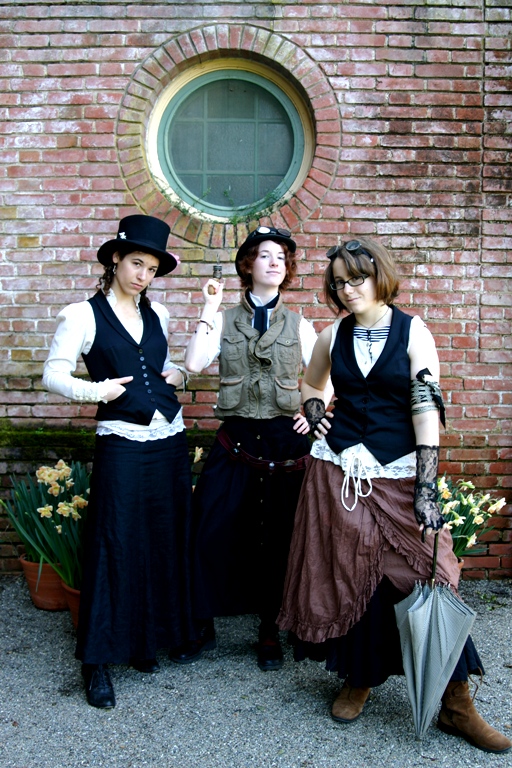
Steampunk fashion has no set guidelines, but tends to synthesize modern styles influenced by the Victorian era. This may include gowns, corsets, petticoats and bustles; suits with vests, coats, top hats and spats; or military-inspired garments. Steampunk-influenced outfits are usually accented with several technological and period accessories: timepieces, parasols, flying/driving goggles, and ray guns. Modern accessories like cell phones or music players can be found in steampunk outfits, after being modified to give them the appearance of Victorian-made objects. Aspects of steampunk fashion have been anticipated by mainstream high fashion, the Lolita fashion and aristocrat styles, neo-Victorianism, and the romantic goth subculture.
Steampunk became a common descriptor for homemade objects on the craft network Etsy between 2009 and 2011, though many of the objects and fashions bear little resemblance to earlier established steampunk descriptions. Thus the craft network may not strike observers as 'sufficiently steampunk' to warrant the description. Comedienne April Winchell, author of the book, Regretsy: Where DIY meets WTF, catalogs some of the most egregious and humorous examples on her website,"Regretsy." The blog is popular among steampunks and even inspired a music video that went viral in the community and was acclaimed by steampunk notables.

Steampunk Popularization (part 5 of 5)

Music

Steampunk music is very broadly defined, as Caroline Sullivan says in The Guardian: "Internet debates rage about exactly what constitutes the steampunk sound." This range of steampunk musical styles can be heard in the work of various steampunk artists, from the industrial dance/world music of Abney Park, the folk rock of Steam Powered Giraffe, the straightforward Punk of The Men That Will Not Be Blamed For Nothing, the inventor/singer-songwriter creations of Thomas Truax or of the 'mad scientist' of 1980s fame, Thomas Dolby, the Carnatic influenced music of Sunday Driver, the "industrial hip-hop opera" of Doctor Steel, the darkwave and progressive rock sounds of Vernian Process, the Unextraordinary Gentlemen, the electronic sounds of The Wet-Glass RO, Darcy James Argue's 18-piece big band Secret Society and the musical storytelling of Escape the Clouds. The British-American composer David Bruce's 2010 octet 'Steampunk' was commissioned by Carnegie Hall.
Joshua Pfeiffer (of Vernian Process) is quoted as saying “As for Paul Roland, if any­one deserves credit for spear­head­ing Steampunk music, it is him. He was one of the inspi­ra­tions I had in start­ing my project. He was writ­ing songs about the first attempt at manned flight, and an Edwar­dian air­ship raid in the mid-80’s long before almost any­one else….”
Steampunk has also appeared in the work of musicians who do not specifically identify as steampunk. For example, the music video of Turn Me On by David Guetta featuring Nicki Minaj takes place in a steampunk universe where Guetta creates human droids.

четверг, 4 октября 2012 г.

Art, fashion, and design

Many of the visualizations of steampunk have their origins with, among others, Walt Disney's 20,000 Leagues Under the Sea, including the design of the story's submarine the Nautilus, its interiors, and the crew's underwater gear; and George Pal's 1960 film The Time Machine, with the design of the time machine itself. This theme is also carried over to Disney's theme parks in the design of The Mysterious Island section of Tokyo DisneySea theme park.
Steampunk design emphasizes a balance between the form and function. Like the Arts and Crafts Movement, this blurs the line between tool and decoration. Various modern utilitarian objects have been modified by enthusiasts into a pseudo-Victorian mechanical "steampunk" style. Example objects include computer keyboards and electric guitars. The goal of such redesigns is to employ appropriate materials (such as polished brass, iron, wood, and leather) with design elements and craftsmanship consistent with the Victorian era, rejecting the aesthetic of industrial design.
The artist group Kinetic Steam Works brought a working steam engine to the Burning Man festival in 2006 and 2007. The group's founding member, Sean Orlando, created a Steampunk Tree House (in association with a group of people who would later form the Five Ton Crane Arts Group) that has been displayed at a number of festivals. The Steampunk Tree House is now permanently installed at the Dogfish Head Brewery in Milton, Delaware.
In May–June 2008, multimedia artist and sculptor Paul St George exhibited outdoor interactive video installations linking London and Brooklyn, New York, in a Victorian era-styled telectroscope. Utilizing this device, New York promoter Evelyn Kriete organized a transatlantic wave between steampunk enthusiasts from both cities, briefly prior to White Mischief's Around the World in 80 Days steampunk-themed event.

In 2009 artist Tim Wetherell created a large wall piece for Questacon representing the concept of the clockwork universe. This steel artwork contains moving gears, a working clock, and a movie of the moon's terminator in action. The 3D moon movie was created by Antony Williams.
From October 2009 through February 2010, the Museum of the History of Science, Oxford hosted the first major exhibition of steampunk art objects, curated and developed by New York artist and designer, Art Donovan who also exhibited his own "electro-futuristic" lighting sculptures and presented by Dr. Jim Bennett, museum director. From redesigned practical items to fantastical contraptions, this exhibition showcased the work of eighteen steampunk artists from across the globe. The exhibition proved to be the most successful and highly attended in the museum's history and attracted more than eighty thousand visitors. The event was detailed in the official artist's journal, "The Art of Steampunk" by curator Donovan.

2012 saw the debut of the Mobilis in Mobili: An Exhibition of Steampunk Art and Appliance art exhibit. Originally located at New York City's Wooster Street Social Club (itself the subject of Television series NY Ink), the exhibit featured working steampunk tattoo systems designed respectively by Bruce Rosenbaum of ModVic and owner of the Steampunk House, Joey "Dr. Grymm" Marsocci., and Christopher Conte showing very different approaches. "bicycles, cell phones, guitars, timepieces and entertainment systems" rounded out the display.

среда, 3 октября 2012 г.

Steampunk Popularization (part 4 of 5)

Television and film

The 1965 television series The Wild Wild West, as well as the 1999 film, featured many of the elements of advanced steam-powered technology set in the Wild West time period of the United States.
The 1982 American TV series Q.E.D., set in Edwardian England, starred Sam Waterston as Professor Quentin Everett Deverill (the series title is the character's initials,as well as the Latin phrase quod erat demonstrandum, which translates as "which was to be demonstrated"). The Professor was an inventor and scientific detective, in the mold of Sherlock Holmes. In the show, the lead character was known primarily by his initials, Q.E.D.
The final scene of the 1990 film Back to the Future Part III implies that the protagonist Emmett Brown, after being stranded in 1880s California, has managed to adapt 1980s technology in a steam-powered context, including the development of a steam-powered train-based time machine.
The Adventures of Brisco County, Jr., a Fox Network 1993 TV science fiction-western set in the 1890s, featured elements of steampunk as represented by the character Professor Wickwire, whose inventions were described as "the coming thing." The short-lived 1995 TV show Legend on UPN, set in 1876 Arizona, featured such classic inventions as a steam-driven "quadrovelocipede" and night-vision goggles, and starred John de Lancie as a thinly-disguised Nicola Tesla. Alan Moore's and Kevin O'Neill's 1999 The League of Extraordinary Gentlemen graphic novel series (and the subsequent 2003 film adaption) greatly popularized the steampunk genre. The Syfy series Warehouse 13 features many steampunk-inspired objects and artifacts, including computer designs created by steampunk artisan Richard Nagy, aka "Datamancer". Also, the Syfy miniseries Tin Man incorporates a considerable amount of steampunk-inspired themes into a re-imagining of L. Frank Baum's The Wonderful Wizard of Oz.
The BBC series Doctor Who also incorporates steampunk elements in the design of the Doctor's time machine, the TARDIS, first presented in the 1996 American co-production when the TARDIS interior was re-designed to resemble an almost Victorian library with the central control console made up of eclectic and anachronistic objects. Modified and streamlined for the 2005 revival of the series, the TARDIS console continues to incorporate steampunk elements, including a Victorian typewriter and gramophone. Steampunk has begun to attract notice from more "mainstream" sources as well. For example, the episode of the TV series Castle entitled "Punked", which aired on October 11, 2010, prominently featured the steampunk subculture and used Los Angeles-area steampunks as extras Also the music videos from both David Guetta's 'Turn Me On' and Panic at the Disco's 'The Ballad of Mona Lisa' have drawn heavily on steampunk inspirations.
The 19th century detective series Murdoch Mysteries occasionally incorporates elements of steampunk. In the 2012 episode Who Killed the Electric Carriage?, for instance, an inventor develops an electric car that runs on NiCd batteries charged by solar cells, only to have Henry Ford and Standard Oil buy out his company and patents and kill the project. In many episodes, Murdoch himself envisions or invents futuristic devices using contemporary materials.

вторник, 2 октября 2012 г.

Steampunk Popularization (part 3 of 5)

Alternative world

Since the 1990s, the application of the steampunk label has expanded beyond works set in recognizable historical periods, to works set in fantasy worlds that rely heavily on steam- or spring-powered technology.
Fantasy steampunk settings abound in tabletop and computer role-playing games. Notable examples include Myst, Skies of Arcadia, Final Fantasy VI, Final Fantasy VII, Final Fantasy IX, Rise of Nations: Rise of Legends, and Arcanum: Of Steamworks and Magick Obscura.
The gnomes and goblins in World of Warcraft also have technological societies that could be described as steampunk as they are vastly ahead of the technologies of men, but are not magical like those of the Elves.
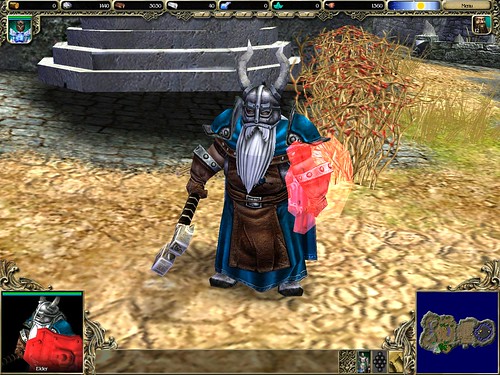
Similarly in the role-playing game series The Elder Scrolls a race of Dwarves, the "Dwemer", are shown to utilise technology which is heavily influenced by steampunk, featuring giant cogs and visible moving parts, as well as steam power, as opposed to the more medieval-based technologies of the species of men, and the magic-based society of the Elven races.
Dungeons and Dragons introduced steampunk elements with the Eberron setting, including automatons called warforged and the use of "technological" magic through items such as the lightning rail and airships.
Amidst the historical and fantasy sub-genres of steampunk is a type which takes place in a hypothetical future or a fantasy equivalent of our future, involving the domination of steampunk-style technology and aesthetics. Examples include Jean-Pierre Jeunet & Marc Caro's The City of Lost Children (1995), anime film Steamboy (2004), Turn A Gundam (1999–2000), Trigun,and Hayao Miyazaki's post-apocalyptic anime Future Boy Conan (1978), and Disney's film Treasure Planet (2002). In 2011, musician Thomas Dolby heralded his return to music after a 20 year hiatus with an online steampunk alternate fantasy world called the Floating City, to promote his album, A Map of the Floating City

Fantasy and horror

Kaja Foglio introduced the term "Gaslight Romance", gaslamp fantasy, which John Clute and John Grant define as "steampunk stories ... most commonly set in a romanticized, smoky, 19th-century London, as are Gaslight Romances. But the latter category focuses nostalgically on icons from the late years of that century and the early years of the 20th century--on Dracula, Jekyll and Hyde, Jack the Ripper, Sherlock Holmes and even Tarzan--and can normally be understood as combining supernatural fiction and recursive fantasy, though some gaslight romances can be read as fantasies of history." Some, such as author/artist James Richardson-Brown use the term steamgoth to refer to steampunk expressions of fantasy and horror with a "darker" bent.

понедельник, 1 октября 2012 г.

Steampunk Popularization (part 2 of 5)

Victorian

In general, the category includes any recent science fiction that takes place in a recognizable historical period (sometimes an alternate history version of an actual historical period) in which the Industrial Revolution has already begun, but electricity is not yet widespread. It places an emphasis on steam- or spring-propelled gadgets. The most common historical steampunk settings are the Victorian and Edwardian eras, though some in this "Victorian steampunk" category can go as early as the beginning of the Industrial Revolution.

Some examples of this type include the novel The Difference Engine, the comic book series League of Extraordinary Gentlemen, the Disney animated film Atlantis: The Lost Empire, the Anime series Fullmetal Alchemist and the roleplaying game Space: 1889. Some, such as the comic series Girl Genius, have their own unique times and places despite partaking heavily of the flavor of historic times and settings.
Karel Zeman's film The Fabulous World of Jules Verne (1958) is a very early example of cinematic steampunk. Based on Jules Verne novels, Zeman's film imagines a past based on those novels which never was. Another early example of historical steampunk in cinema includes Hayao Miyazaki's anime films such as Laputa: Castle in the Sky (1986), containing many archetypal anachronisms characteristic of the steampunk genre.


"Historical" steampunk usually leans more towards science fiction than fantasy, but a number of historical steampunk stories have incorporated magical elements as well. For example, Morlock Night, written by K. W. Jeter, revolves around an attempt by the wizard Merlin to raise King Arthur to save Britain in 1892 from an invasion of Morlocks from the future. The Anubis Gates by Tim Powers involves a cabal of magicians among the beggars and thieves of the early 19th century London underworld.
Paul Guinan’s Boilerplate, a 'biography' of a robot in the late 19th century, began as a website that garnered international press coverage when people began believing that Photoshop images of the robot with historic personages were real. The site was adapted into an illustrated hardbound book Boilerplate: History’s Mechanical Marvel, and published by Abrams in October 2009. Because the story was not set in an alternative history, and in fact contained accurate information about the Victorian era, some booksellers referred to the tome as "historical steampunk."

American West

Another setting is "Western" steampunk, which overlaps with both the Weird West and Science fiction Western subgenres. Several other categories have arisen, sharing similar names, including dieselpunk, clockpunk, and others. Most of these terms were coined as supplements to the GURPS roleplaying game, and are not used in other contexts. Films and literature of this genre include High Moon, Far West, Jonah Hex, and the Will Smith film Wild, Wild West.

воскресенье, 30 сентября 2012 г.

Steampunk Popularization (part 1 of 5)

Literary

The 1981 educational book, Elementary BASIC - Learning to Program Your Computer in BASIC with Sherlock Holmes by Henry Singer and Andrew Ledgar may have been the first fictional work to depict the use of Charles Babbage's Analytical Engine in an adventure story. The instructional book, aimed at young programming students, depicts Holmes using the engine as an aid in his investigations, and offer program listings to perform simple data processing tasks required to solve the fictional cases. The book even describes a possible enhancement to Babbage's machine; a device that allows the engine to be used remotely, through telegraph lines. Companion volumes, Elementary Pascal - Learning to Program Your Computer in Pascal with Sherlock Holmes and From Baker Street to Binary - An Introduction to Computers and Computer Programming with Sherlock Holmes, were also written.
1988 saw the publication of the first version of the science fiction roleplaying game Space: 1889, set in an alternate history in which certain discredited Victorian scientific theories were probable, thus leading to new technologies. Contributing authors included Frank Chadwick, Loren Wiseman, and Marcus Rowland.


William Gibson and Bruce Sterling's 1990 novel The Difference Engine is often credited with bringing widespread awareness of steampunk.This novel applies the principles of Gibson and Sterling's cyberpunk writings to an alternative Victorian era where Ada Lovelace and Charles Babbage's proposed steam-powered mechanical computer, which Babbage called a difference engine (a later, more general-purpose version was known as an analytical engine), was actually built, and led to the dawn of the information age more than a century "ahead of schedule". This setting was different than most steampunk settings in that it takes a dim and dark view of this future rather than the more prevalent utopian versions.
Nick Gevers's 2008 original anthology Extraordinary Engines features newer steampunk stories by some of the genre's writers, as well as other science fiction and fantasy writers experimenting with neo-Victorian conventions. A retrospective reprint anthology of steampunk fiction was released, also in 2008, by Tachyon Publications; edited by Ann and Jeff VanderMeer and appropriately entitled Steampunk, it is a collection of stories by James Blaylock, whose "Narbondo" trilogy is typically considered steampunk; Jay Lake, author of the novel Mainspring, sometimes labeled "clockpunk"; the aforementioned Michael Moorcock; as well as Jess Nevins, known for his annotations to The League of Extraordinary Gentlemen.


Boilerplate. Mechanical Marvel.
While most of the original steampunk works had a historical setting, later works often place steampunk elements in a fantasy world with little relation to any specific historical era. Historical steampunk tends to be science fiction that presents an alternative history; it also contains real locales and persons from history with alternative fantasy technology. "Fantasy-world steampunk", such as China Miéville's Perdido Street Station, Alan Campbell's Scar Night, and Stephen Hunt's Jackelian novels, on the other hand, presents steampunk in a completely imaginary fantasy realm, often populated by legendary creatures coexisting with steam-era and other anachronistic technologies. However, the works of China Miéville and similar authors are sometimes referred to as belonging to the 'New Weird' rather than steampunk.
Self-described author of "far-fetched fiction" Robert Rankin has increasingly incorporated elements of steampunk into narrative worlds, both Victorian and re-imagined contemporary. In 2009, he was made a Fellow of the Victorian Steampunk Society.

пятница, 28 сентября 2012 г.

Roots of Steampunk

          Steampunk is influenced by, and often adopts the style of, the 19th-century scientific romances of Jules Verne, H.G. Wells, and Mary Shelley.

Twentieth-century precursors

Several works of art and fiction significant to the development of the genre were produced before the genre had a name. Titus Alone (1959), by Mervyn Peake, anticipated many of the tropes of steampunk. Remedios Varo's paintings combine elements of Victorian dress, fantasy, and technofantasy imagery. One of the earliest mainstream manifestations of the steampunk ethos was the original CBS television series The Wild Wild West (1965–69), which inspired the film Wild Wild West (1999). The film Brazil (1985) was an important early cinematic influence toward creating the genre.

Origin of the term

Although many works now considered seminal to the genre were published in the 1960s and 1970s, the term steampunk originated in the late 1980s as a tongue in cheek variant of cyberpunk. It seems to have been coined by science fiction author K. W. Jeter, who was trying to find a general term for works by Tim Powers (The Anubis Gates, 1983); James Blaylock (Homunculus, 1986); and himself (Morlock Night, 1979, and Infernal Devices, 1987)—all of which took place in a 19th-century (usually Victorian) setting and imitated conventions of such actual Victorian speculative fiction as H. G. Wells' The Time Machine. In a letter to science fiction magazine Locus, printed in the April 1987 issue, Jeter wrote:
Dear Locus, Enclosed is a copy of my 1979 novel Morlock Night; I'd appreciate your being so good as to route it Faren Miller, as it's a prime piece of evidence in the great debate as to who in "the Powers/Blaylock/Jeter fantasy triumvirate" was writing in the "gonzo-historical manner" first. Though of course, I did find her review in the March Locus to be quite flattering.
Personally, I think Victorian fantasies are going to be the next big thing, as long as we can come up with a fitting collective term for Powers, Blaylock and myself. Something based on the appropriate technology of the era; like 'steam-punks', perhaps.
—K.W. Jeter

Modern steampunk

While Jeter's Morlock Night and Infernal Devices, Power's Anubis Gates, and Blaylock's Lord Kelvin's Machine were the first novels to which Jeter's neologism would be applied, they gave the term little thought at the time. However, they were far from the first modern science fiction writers to speculate on the development of steam-based technology or alternate histories. Keith Laumer's Worlds of the Imperium (1962) and Ronald W. Clark's Queen Victoria's Bomb (1967) apply modern speculation to past-age technology and society. Michael Moorcock's Warlord of the Air (1971) is another early example. Harry Harrison's novel A Transatlantic Tunnel, Hurrah! (1973) portrays a British Empire of an alternative year 1973, full of atomic locomotives, coal-powered flying boats, ornate submarines, and Victorian dialogue. In February 1980 Richard A. Lupoff and Steve Stiles published the first "chapter" of their 10-part comic strip The Adventures of Professor Thintwhistle and His Incredible Aether Flyer.
The first use of the word in a title was in Paul Di Filippo's 1995 Steampunk Trilogy, consisting of three short novels: "Victoria," "Hottentots," and "Walt and Emily," which, respectively, imagine the replacement of Queen Victoria by a human/newt clone, an invasion of Massachusetts by Lovecraftian monsters, and a love affair between Walt Whitman and Emily Dickinson.

четверг, 27 сентября 2012 г.

More Than a Culture

For one day let's trust Wikipedia and find out what the SteamPunk culture really is.

Steampunk is a genre that originated during the 1980s and early 1990s and incorporates elements of science fiction, fantasy, alternate history, horror, and speculative fiction. It involves a setting where steam power is widely used—whether in an alternative history such as Victorian era Britain or "Wild West"-era United States, or in a post-apocalyptic time —that incorporates elements of either science fiction or fantasy. Works of steampunk often feature anachronistic technology, or futuristic innovations as Victorians might have envisioned them, based on a Victorian perspective on fashion, culture, architectural style, and art. This technology includes such fictional machines as those found in the works of H. G. Wells and Jules Verne, or the contemporary authors Philip Pullman, Scott Westerfeld, and China Mieville.
Other examples of steampunk contain alternate history-style presentations of such technology as lighter-than-air airships, analog computers, or such digital mechanical computers as Charles Babbage and Ada Lovelace's Analytical Engine.

 
Fashion trend or something bigger?

Steampunk also refers to art, fashion, and design that are informed by the aesthetics of steampunk literature. Various modern utilitarian objects have been modded by individual artisans into a pseudo-Victorian mechanical "steampunk" style, and a number of visual and musical artists have been described as steampunk.